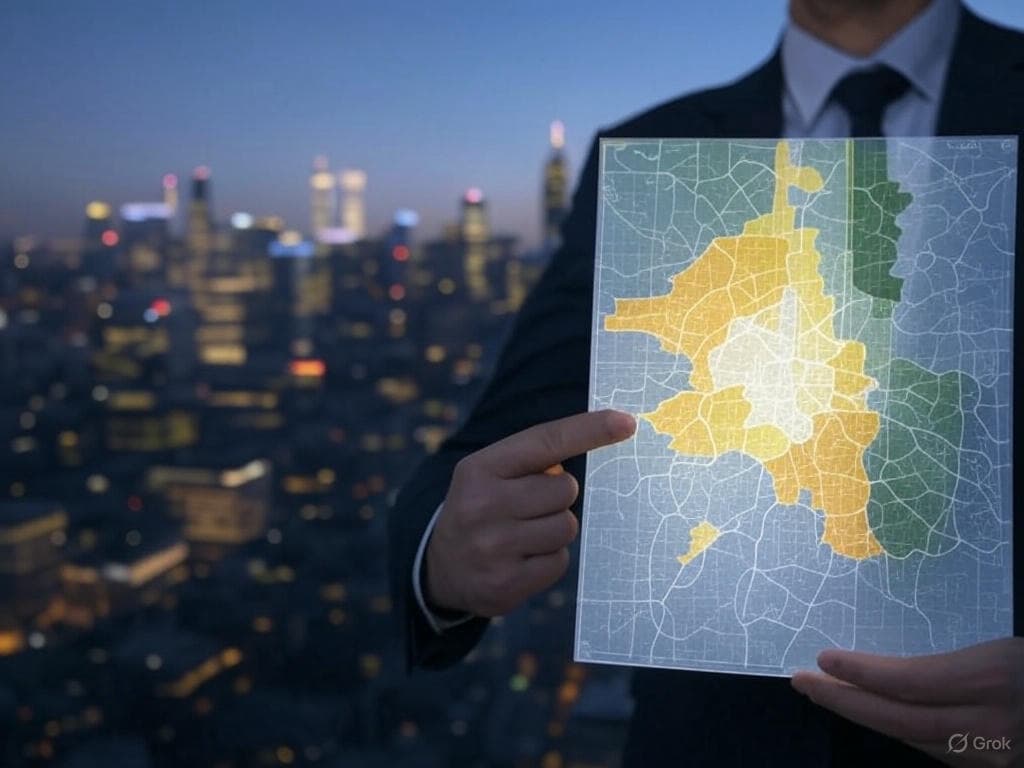
Our client, a real estate consulting firm, faced challenges in accurately quantifying demand for retail developments. Their outdated methods led to imprecise catchment area definitions, subjective population estimates, and inefficient data management. We implemented a solution using the Mapbox isochrone API and GeoPandas to create precise catchment areas and automate population calculations. This transformation reduced analysis time by 93%, improved population accuracy by 75%, and ensured 100% reusability of hard data across projects. Our solution empowered the client to deliver more accurate and timely insights to their clients and financial partners.
The Challenge
The client encountered several critical obstacles in their demand analysis process:
- Inaccurate Catchment Area Mapping: Analysts used manual methods to draw catchment areas in PowerPoint, leading to imprecise isochrones that didn't reflect actual travel times.
- Subjective Population Estimates: Population calculations relied on visual guesses of administrative unit overlaps, introducing significant errors.
- Complex and Time-Consuming Process: The manual workflow was difficult to teach and took three days per project, limiting scalability.
- Data Repurposing Difficulties: Valuable data was stored in nonstandard formats with unclear sourcing, making it hard to reuse for future projects.
These issues compromised the quality of insights and hindered the firm's ability to meet client expectations efficiently.
Our Solution
To address these challenges, we developed a comprehensive, technology-driven solution:
- Precise Catchment Area Definition: We utilized the Mapbox isochrone API to generate accurate catchment areas based on real travel times by car, divided into three proximity levels with modulated capture rates.
- Automated Population Calculation: Using GeoPandas, we calculated the exact population within each catchment area by determining the overlap between administrative units and isochrones.
- Standardized Data Management: We stored data in JSON format, linking coordinate-defined shapes to population and socioprofessional category (SPC) data for easy reuse.
- Automated Reporting and Deliverables: We developed tools to automatically generate comprehensive reports and professionally formatted slides, eliminating manual formatting efforts.
This solution not only enhanced accuracy but also significantly reduced the time and effort required for each project.